
Season 2, Episode 2 - Courageous Presence: How Yoga Shapes Modern Legal Leadership
Or listen & subscribe in your favorite app: Apple Podcasts AUDIBLE SPOTIFY PlayerFM YouTube
Yoga Philosophy for Everyday Living, Season 2, Episode 2 Courageous Presence: How Yoga Shapes Modern Legal Leadership Welcome to Yoga Philosophy for Everyday Living, where we explore how ancient wisdom supports modern leadership, work, and life. This episode is on Courageous Presence: How Yoga Shapes Modern Legal Leadership. I am joined by two extraordinary leaders who embody what it means to lead with presence, clarity, and courage: Carolyn Herzog, Chief Legal Officer at Elastic, and Alice Geene, former Chief Legal Officer at Paycor.
SHOW NOTES
Courageous Presence: How Yoga Shapes Modern Legal Leadership, Season 2, Episode 2
Ever wondered what courageous leadership really looks like in the legal world?
In this episode, two powerhouse CLOs share how yoga helps them lead with clarity, courage, and presence—especially in high-pressure moments.
Listen as we explore:
🌿 How mindful presence transforms decision-making
💛 What courageous leadership looks like in real time
🧘♀️ Creating space to build trust across legal teams
✨ The role of truthfulness (satya) in difficult conversations
🤝 And why intentional, grounded leadership matters now more than ever
If you’re a lawyer, legal leader, or anyone seeking more presence and less pressure in your work, this conversation is for you.
IN THIS EPISODE:
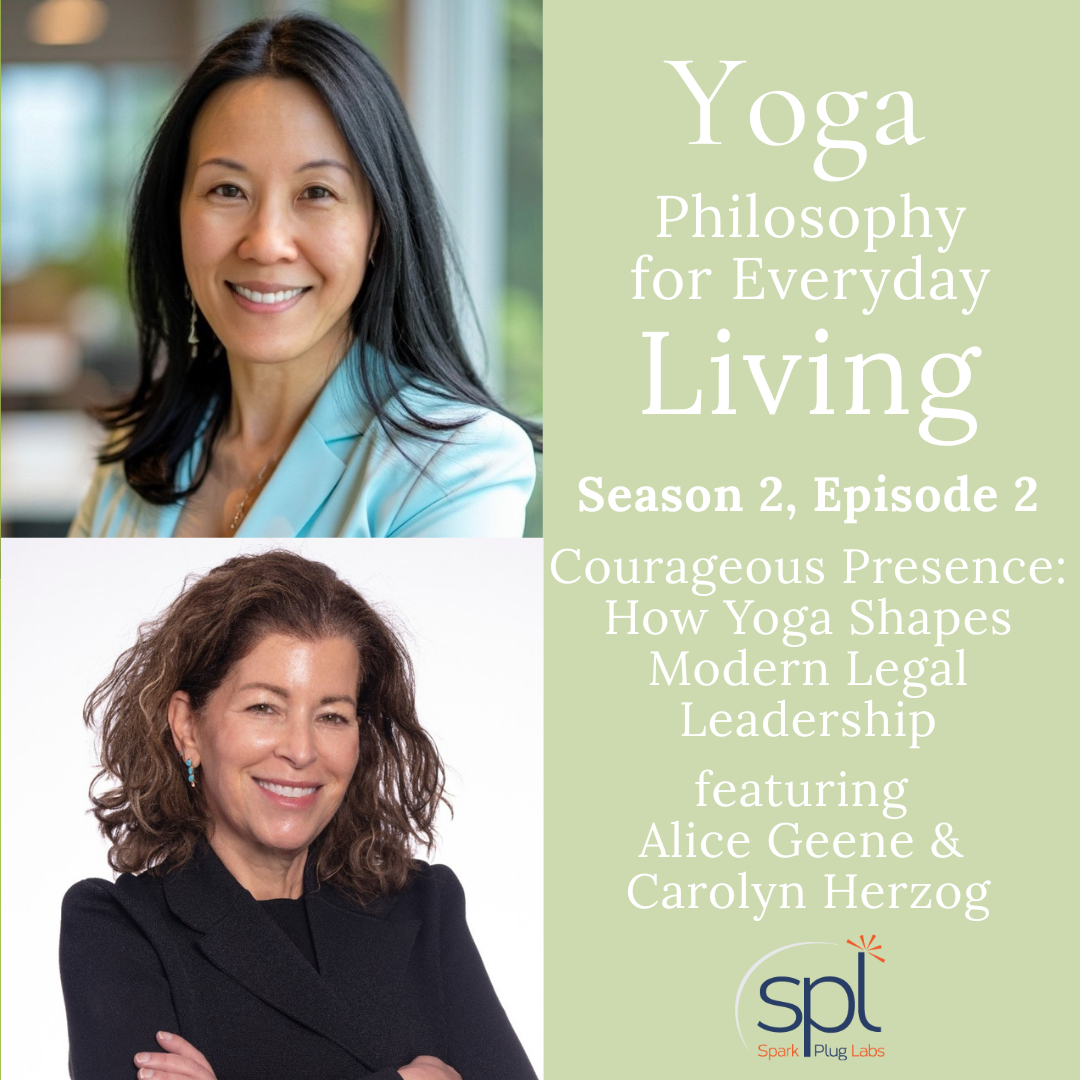
In this episode, Monica interviews two extraordinary leaders who embody what it means to lead with presence, clarity, and courage: Carolyn Herzog, Chief Legal Officer at Elastic, and Alice Geene, former Chief Legal Officer at Paycor. Both Carolyn and Alice have navigated high-pressure, high-stakes legal environments while bringing yoga, mindfulness, and intentionality into the heart of their leadership. Their practices inform how they show up for their teams, how they make decisions rooted in truth, and how they create space for trust, connection, and community.
In this conversation, we explore how mindful leadership can transform not only how we work—but how we relate, communicate, and cultivate environments where people feel seen and supported.
Themes we explore:
• How mindful presence transforms decision-making
• What courageous leadership looks like in real time
• Creating space to build trust across legal teams
• The role of truthfulness (satya) in difficult conversations
• And why intentional, grounded leadership matters now more than ever
Learn more and find our guests online:
Carolyn Herzog is the Chief Legal Officer at Elastic, a global technology company known for its search, security, and observability solutions. With extensive experience leading legal, compliance, and public policy teams across high-growth, high-impact tech environments, Carolyn is widely recognized for her thoughtful, values-centered approach to leadership. She is the recipient of NACD Directorship 100 in recognition of her role in board governance. She is a longtime practitioner of yoga and mindfulness, bringing presence, intentionality, and courage into the boardroom and across her global teams. Carolyn champions trust, inclusion, and clarity as the foundations of modern legal leadership.
Alice Geene is a long-time c-suite leader and chief legal officer in technology companies and the former Chief Legal Officer at Paycor, a leading HR and payroll technology company focused on empowering people-first workplaces. Throughout her career, Alice has built strong, collaborative legal teams rooted in openness, integrity, and authentic communication. A dedicated student of yoga and mindfulness, she infuses her leadership style with grounded presence, compassion, and the courage to lead with truthfulness (satya). Alice is known for creating space where teams feel supported, connected, and able to thrive.
TRANSCRIPT
(Please excuse any errors in the transcription.)
Hello and welcome to yoga philosophy for everyday living where we explore how ancient wisdom supports modern leadership, work, and life. I'm your host Monica Phillips and today's episode is on courageous presence, how yoga shapes modern legal leadership.
I am joined by two extraordinary leaders who embody what it means to lead with presence,
clarity, and courage. Carolyn Herzog, chief legal officer at Elastic and
Alice Geene, former chief legal officer at Paycor.
Welcome.
Thank you.
It's great to be here.
Thank you so much, Monica.
Both Carolyn and Alice have navigated high pressure, high stakes, legal environments
while bringing yoga, mindfulness, and intentionality into the heart of their leadership.
Their practices inform how they show up for their teams, how they make decisions rooted
in truth, and how they create space for trust, connection, and community.
In this conversation, we'll explore how mindful leadership can transform not only how we work,
but how we relate, communicate, and cultivate environments where people feel seen and supported.
So let's dive in.
I'd love to introduce you both just briefly.
Carolyn Herzog is the chief legal officer at Elastic, a global technology company known
for its search, security, and observability solutions with extensive experience leading
legal compliance and public policy teams across high growth, high-impact tech environments.
Carolyn is widely recognized for her thoughtful Value-centered approach to leadership.
She is the recipient of the NACD Directorship 100 in recognition of her role in board governance
excellence. She is a long time practitioner of yoga and mindfulness, bringing presence, intentionality, and courage into the boardroom and
across her global teams. Carolyn champions trust, inclusion, and clarity as the foundations of modern legal leadership. And I know that anyone who's been part of her teams, present or past, can champion and support how incredible it is to work with her.
Alice Geene is a long time C-suite leader and chief legal officer in tech companies and the former chief legal officer at Paycor, a leading
HR and payroll technology company focused on empowering people first workplaces. Throughout her career, Alice has built strong collaborative
legal teams rooted in openness, integrity, and authentic communication. A dedicated student of yoga and mindfulness infuses her leadership style with grounded presence, compassion, and the courage to lead with truthfulness. Alice is known for creating space where teams feel supported, connected, and able to thrive. And I've also had the pleasure of meeting your past colleagues, Alice, who are have just been grateful for the experience to learn from your leadership for both of you.
So welcome again. I'm so glad you're here. And I'd love to start the conversation by talking about how you both got here.
Alice on our first conversation, you mentioned that you were also a yoga teacher had done yoga teacher training. I'd love to hear what originally drew you to the practice of yoga and what's important about yoga for you as a leader. Yeah, so I remember the first time you and I met Monica and then us discovering that we shared this interest in this passion. And you know, it's so funny because it is so it's such a central part of my life. I actually began practicing yoga almost accidentally. I was a summer associate in a big New York law firm. And one of my colleagues, I was on a case with him. His fiancée was a yoga instructor in Manhattan.
And she invited me to a class. And it was a wonderful experience.
And I loved it. And I kept going back. I will tell you, I think for a long time, like yoga to me was about beautiful poses. And it was about stress relief. And I think all of those things are valuable and really, really wonderful. And that was how I sort of treated yoga in my life as this interest or pursuit. And this took some time. I think it took years, but then it began to become something much more meaningful. And I started to recognize that it was a practice that brought gratitude and awareness of the importance of community and a way of seeing both inwardly and outwardly the gifts that people have to offer. And it became, I think, not just a physical practice, but really sort of a mental, spiritual
and kind of outlook on life practice. And it became so important to me that ultimately in 2019, I decided to get a yoga teacher certification,
which I did. I did a 100 hour teacher certification.
I even taught in a gym in Chicago where I live for about four months. And that was a really wonderful experience. I haven't really returned to formally teaching in a gym or studio environment since then. But it's something that I just try to integrate into my work and my relationships and my outlook on life at this point.
It's fantastic. Thank you. Carolyn, how about you?
What was your journey to yoga and how does it show up for you as your role and as a leader?
Yeah, it's such a fun question. And this is such a fun way to spend part of our day.
You made me think because I was trying to remember when I started doing yoga.
And my earliest memory that I can remember doing yoga was when I was pregnant with my
first child.
And exercise has always been a way for me to have some stress relief to get out and
do something where you feel like you did something for yourself because we're working.
And then when you become working moms or just all the things that we're doing in leading
teams, you're always thinking about other people. And it was the one thing I could do for myself.
And I think when I couldn't do other things from an exercise perspective, I ended up taking
a yoga class, which is kind of funny being pregnant. If you've seen pregnant ladies doing yoga, it's a
challenging twisty-turny act to navigate. But what I found was that it aligned really
well with my personality. I'm not a particularly competitive person.
So whenever I've been on teams, I was always like, "As long as we're all doing our best, it's great."
But I do think I'm pretty ambitious. And so yoga to me has been a really interesting
journey because it is so dependent on the instructor.
The instructor really creates the experience, creates the environment.
And I've tried yoga in various places where I've lived and traveled and finding the studio
or the place that you can really call home and really developing the community around
you while you're just personally challenging yourself.
So like Alice, I think initially it's sort of like, "Can I do that pose?"
Or "Could I do that pose last week, but I can't do it today and why?"
And it does have an iterative process where your experience is unique every time you go.
But maybe once you finally get one pose and you try to work on it even more and think
at my age now too, there's things that I'm just quite proud of myself for being able
to do in a yoga class.
I'm also not a great meditator. I have tried and it just makes my brain busier. But yoga is the one place where I have found I
can have a more meditative experience. I can actually find that I'm a better person walking
out of yoga class than I was going in.
And that is reflected in my day-to-day life and in my day-to-day work.
And it's something that I enjoy talking about. I'm actually dressed for yoga today.
I didn't even do that intentionally because of our podcast.
But I find when I put on my yoga clothes in the morning and I know that I'm going to my
yoga class at night, it's on my mind and it's something that I commit to.
And I feel perfectly comfortable telling others on my team, "Well, I'll be at yoga class from
six to seven. I'm not available then, but you can talk to me before or you can talk to me after."
I love those journeys to yoga so far. And as an executive coach, I meet a lot of busy
executives and hyper-achievers who are afraid to pause and sometimes have some reflection
like, "Oh, I know I should do this," but there's a sense that it might weaken them.
Talk to me about how you both integrate mindfulness and presence and this practice that you've
learned on the mat into the boardroom, into the leadership team to model how that can
actually, which is what we all know, make us better performers, better teammates, better
community members.
So, I mean, I'll maybe start by offering, you know, my most recent full-time job ended
in the spring and I've had time to rest and recharge and reflect a little bit.
And I don't know that I was necessarily doing it sort of intentionally or consciously at
the time, but like integrating some of the principles of yoga, like we're all stronger
in community or every individual is where they are and they have challenges and they
also have gifts to offer and practicing yoga is about finding and tapping those gifts.
I think I found that as a leader, I tried to integrate some of those learnings and those
principles with how I put together teams and I coached teams and I tried to help teams
work together and work with people on very high stakes things in technology companies,
which can often be very fast-paced and very full of complexity and present in-house legal
departments with all kinds of multiple daily challenges.
And, you know, I think I would say I feel like it's hard to kind of unpack the data around
this, but being intentional, helping everybody to understand that they had a unique talent
to contribute to a question, a project, an initiative, and also that everybody, you know,
had a challenge and that that's inherent in being human.
And that part of it was, you know, you become better by acknowledging the challenge and
trying to stretch yourself into it in an appropriate way so that you can learn and so that everybody
around you can learn.
You know, it's taken me I think some months to maybe articulate and put some words to
it, but I feel like, you know, yoga has been very integral in how I tried to approach the
job of being a CLO and building teams and getting people to work effectively together
and with internal colleagues at companies.
It's so interesting. I think a lot about, you know, one of the principles
of yoga, which is practice, not perfection, and how that connects to our work every
day because particularly as in-house leaders, perfection is an elusive goal, right?
It is just not something you can't execute on the things that we need to deal with on
a day-to-day basis.
You can't manage in a crisis if you're aiming for perfection.
But the more that you practice, the more that you exercise connecting to others and
what others know and how they can bring that to your practice, the better off you are.
Yoga is so individualistic that even when instructors are, you know, showing somebody
how to do a pose, they'll acknowledge on a regular basis, this is going to be different
for you.
You may have one side that's better than any other. You may have sides that vary from day-to-day.
You may balance differently than others. Your body and how your body works is going to reflect how you do yoga.
And so there may be some poses that you're great at and that are easier for you and others
that are much harder to achieve or maybe even impossible to achieve because your body just
won't stretch that way.
I also think about the focus time because, you know, I can remember starting work before
cell phones and before we were all distracted by social media and, you know, getting a slack
and an email and a text and the various ways that we can communicate with each other today
and being able to spend some time concentrating on just what you're doing in that moment is
really important.
It's important for individual contributors.
It's important for leaders figuring out when do you just dive in and when do you take a
breath and give yourself a pause and think about what you're going to do next is really,
really important.
I hear in what you're saying, Carolyn, in this idea of Satya, which is one of the five yamas,
the first of the eight limbs of yoga.
And Satya means truthfulness and it is really this way of acting and thinking with integrity.
And it's a lot different than like, oh, I didn't lie, right?
Truthfulness is like you're saying this range of being perfect that we are not perfect.
This is actually in a Ted Lasso scene. I was rewatching Ted Lasso recently.
They had this whole conversation about humans are not perfect.
And a lot of times, especially I see this so often in the legal industry where associates
are hiding out in their office afraid to ask for help until they get the perfect answer.
And Satya, I feel can really help us shine a light on how we are part of a community,
part of a team.
And when we make that commitment, when we have the courage to be vulnerable to say,
I need help with this, or how would you approach this, or have you done this before?
What was the reaction?
What was the result?
How could I make this better?
We actually get something so much better.
But some cultures don't allow for that courage to create trust.
And then it keeps people from leaning into that Satya, the truthfulness of the experience.
Yeah, there's a vulnerability in that too, right? To be able to be vulnerable and say, I don't
know, but let me think about it.
Let me go ask some people that I know who may be able to contribute to the answer.
And the answer isn't always, again, in perfection. You have to figure out when do I need an answer right
now because I'm dealing with an emergency? Or when do I need to do some more analysis and scope?
And I think the more senior you become, the more comfortable you can also become with
not knowing everything and having a team around you of experts who are the person who, you
know, who really knows this one particular area and you know how to draw in that expertise
from others.
And that's what we look for in yoga instructors too, right?
Is that you get a different experience from different people.
Some people are just amazing at providing that sort of meditative instruction.
Some people are really good at helping you balance better and thinking about how you're
structuring your body in a way to keep a more stable balance.
Carolyn, can I ask you, have you in the practice of it regularly in a workplace environment
been able to see team members grow into comfort with challenge and opportunity by practicing,
you know, it's authentic and it's okay to not be perfect and to say, I don't know and
to reach out and to ask for help?
It's such a great question, Alice. And I think it goes a lot to leadership and what
kind of environment are you creating?
You know, Monica, you touched on this and that if you are afraid to ask a question,
if you're afraid to show that you don't know something, then you have to, I think as a
leader, you have to step back and think, well, why is that person afraid?
It's not just this person is too perfectionist or there's something wrong with them.
You have to think about, oh, what's the environment that I'm creating to create a safe space so
that people know to share their thoughts and to ask questions.
And particularly now, as we're going through this transformative time with AI and people
are looking at the future of their careers, it's going to be even more important for people
to think about, well, how am I actually taking the knowledge that I have and applying judgment
or asking questions and thinking through the process?
That's the greater value that we provide, not providing the perfect answer.
Can I just laugh for a second that we said AI, I was doing a little like mental math
in my head, how long it would take during the podcast to raise AI, because it's like
all over everyone's minds. And like, you know, yoga is about like
the practice of being human. And like, sometimes it's very hard to square that
with this world where there's so much pressure to bring it in to how we're working.
And the challenge in my mind is like, how do you bring it in, which we all we can see,
like we're all called upon to do it. But how do we then retain the best of what is human,
which is like, I think, as essence, what yoga is about.
It's also what this practice is about, like what the legal practice is about.
It's about, I mean, when you think about how law is formed, it starts first in culture,
right?
And then culture then translates into law and then law is then interpreted again by
the human experience. And so there is no perfection in law either. There's only this evolving experience and interpretation
of law, which is very, and if you think about employment law and how different employment law is in France versus
in, you know, United States, these are huge cultural shifts.
And we're going through a cultural shift now with AI. I think about it all the time.
I work in an AI company, but I also think about it in ways in terms of the governance
and the responsibility we talked about, you know, leading with authenticity and truthfulness
and integrity.
Hey, AI is going to change the way we're working, but it also can be a great equalizer.
As you said, Alice, AI can't do yoga, right?
AI can't be mindful.
AI can't reflect on the various situations and say, well, there's no perfect answer,
but let's think through it.
It can't give you a certain amount of gets. It can't balance the data with judgment.
Right.
It will never replace that.
We were talking before we started recording about the Woo.
I had a vision recently, about maybe six months ago, about a person in collaboration with
an AI figure. And the AI figure was kind of like, you know, you can just let it set it down.
You have everything you need within you. And I feel like so often we are so attached to
what's here that we forget about what's here. And we forget that we're not just up here.
And we're always like driving with like more thought mind, right?
And we forget that we have a heart, that we have a soul, that we have a body.
And we maybe know more than we think we know, but we're afraid to put down our phones, put
down our AI agents, put it down and say, what am I, what am I, what do I know is true
in my body?
How do I see another person as a human being and show up in this moment to meet them with
what they have?
And sometimes it is that that is needed, this human experience to say, I see that you made
a mistake because you're human.
And I see you and recognize that you can do better. And I want to help you get there.
Not here's the perfect answer, right? Or I see that there was a crisis that
we had some poor judgment. But what could we do?
Or the opposite, right?
We had this outcome because seven people came together and created a solution that was so
much better than we could have done on our own. Because we were hearing about the experiences of
our customers, of our community, of this creation.
So, you know, I think it's an interesting way to approach how yoga connects to work.
And Alice, I've been sharing your thoughts on this. It's for me, as I was hearing you talk, Monica, I
was also thinking, yeah, but there's crisis every day and there's responses and there's small
mistakes and then there's catastrophic mistakes.
So to me, it's about how do you create an environment for practice so that people can
move quickly, can make decisions quickly, can feel comfortable in that and can recover
when there's a mistake. Or can recover and pivot when they say, like, that's
not working, let's go in another direction. And I do think there's elements in yoga.
You could equate a lot of things in terms of, well, you know, this isn't, I'm not feeling
balanced on my left side today. So what is it?
Am I not looking in the right place?
Am I not, you know, focused on my core?
What are the tricks that I've learned?
What are the things that I've practiced to be able to get there?
I know, Alice, what do you think?
I mean, I think you're right in the sense that, you know, while I don't think yoga practice
was sort of like constructed with how do I like help in-house legal teams be effective
at like managing complexity and crisis and pace, there's a lot in it that can really
help in those situations.
And I mean, I think one thing I would say is, you know, Monica asked about Satya, like
truthfulness.
And I think that that principle of if you did the work, did the work, right, if you
got your data, you thoughtfully laid out the options and you said, I believe this is the
right path, then that is the Satya, the truth of it. And yes, it's very high stakes and
everybody is very emotional.
And there's people who don't agree with each other. But you did the work and I think that you shouldn't
back down from saying it authentically and truthfully and directly.
I think you should also be open-minded.
And, you know, the reason we bring together lots of smart people from different functions
and with different perspectives is to try to achieve, you know, some direction that
reflects everybody's needs and goals.
But like, you know, just sort of like having confidence that, you know, if you did the
work around it, then that's the truth of it.
And you should have the confidence in that to say it and to say, you know, this really
came from a place of, you know, understanding and knowledge and thoughtfulness.
I think that that's where the practice of yoga regularly and consistently sort of like
helps bring that into the workplace and how you communicate and how you work with other
people to try to get to decisions.
Yeah, it does help you calm your mind, right, to think through things in a very sort of
sequential way. Like, Monica, you talked about woo and
like, I'm not particularly woo. I don't think in my day-to-day or my practice, but
I do think I'm very people-oriented, which is not always equated to the legal profession
as being about people. But I do think about what individuals
bring to the table. They're individual strengths.
You know, there's people that you want in a crisis. There's people that you actually want to be the people that sit back and think through
all the facts to inform you as you move towards a new strategy, something that is, you know,
always like AI again, right, that you just you haven't answered all the questions before.
There are no specific answers. We're still navigating that.
And there's people who are just the great thought leaders who spend the time to say,
well, what about this and what about that? And again, creating that safe space to allow
for that kind of conversation. I know a lot of leaders. And to say we are where we are, which is we know
some of it and we don't know some of it or a lot of it. And that's okay, because that is where we are.
I meet a lot of leaders who know this intuitively know about the different models of leadership,
know about creating safe space and a foundation of trust, know what it you know, the impact
it can make to create mindfulness and the practicality of it is not always so easy.
How do you how have you each practically created space for your teams to feel heard,
grounded and safe to speak honestly? My last company pay core where I was for nearly five
years, I led a virtual team of 16 people, lawyers and non lawyer professionals.
And it was, you know, very classic tech company, extremely fast paced every day, multiple challenges
and everyone had a very big job and a very big role to play and trying to navigate all
of those questions and challenges.
And I, I think that I tried very hard to bring the team together in person, three to four
times a year for in person offsights. And they were not just around the questions of
our company, you know, or the initiatives of the day.
You know, I always try to create some, some space
for like, what is it that we should
be reflecting on and trying to change positively
in order to be more effective and better as
a team and for our organization.
And I think that at the heart is sort of what yoga
calls upon us to do, which is to look
inward and to say, like, what is,
you know, what is positive?
That you want to name and that you want
to practice in your life.
And I think that that's what we were doing, even
though we weren't calling it yoga or
meditation.
Actually, I did bring in, you know, towards the
end of our time together, some mental
health and wellness speakers, specifically for
lawyers, I think that there's definitely
an industry in this because law is so high pressure.
I'm sure Carolyn is familiar with this as well.
And it was interesting because while we didn't
necessarily practice yoga, they definitely
brought in a lot of meditation and breath work to
just pause the system and to get everybody
to slow down and breathe and reflect.
Yeah, I am angry.
Alice, I think also, well, I've actually I had
my offsite a couple weeks ago with my
team.
And also I run a virtual team.
So so this team is quite different from other teams
where I've been in the office or were
more centralized.
People are everywhere and they really come as they are.
And it's it's important to create a space where people do get to know each other and
build that trust and you know, and know that they can rely on people and can ask questions
when it's not necessarily something that they know about in advance.
I also think there's something different about being in person.
And we've actually done like early morning, you know, optional exercise.
And I've led a yoga class with the team for that with with another person.
And just I think integrating whatever it is that helps you be more mindful.
Some people need to run and just get into that space. Some people play music, whatever it is that gives
you that time to reflect and realize that work is important.
But the response that you have shouldn't always be a personal response.
It should be an intellectual response. And you need to give yourself that space and that
mental well being to be able to respond to challenging situations or unfamiliar situations
in a very practical, pragmatic way. You know, if you respond with emotion inside a company
and particularly as things are moving quickly, we both work in tech and things move incredibly quickly.
That's not going to help you bring others along. It's not going to help you get to the right answer.
So you have to be able to reflect and be able to respond with facts, with process, with
inclusion to be able to get to the right answers quickly. How was it received to practice yoga
and meditation at the websites? It was great. It was it was optional, right?
It was it.
One thing is that it's not it wasn't a lot of this isn't coming from me necessarily.
I'd like to think I'm creating this space for people to have this kind of optionality.
But then we have a development committee within our team. And there are people that said we really want
to focus on wellness and well being. And I said, fantastic. I fully support it.
So sometimes it just comes from your support. And then one team member who is also practicing
yogi asked, would I would I co teach this class?
And we had other people that wanted
to go out for a run.
Other people that one group even went and did
parkour, you know, and some people just
want to walk and talk.
Some people want to sleep in.
So I think creating an optional environment where
you create just the opportunity and
awareness that it's available to people
is something that is quite nice.
I did it with the board of directors and the executive
team at a quarterly board meeting.
I let it.
It was an intimidating experience.
That would be very intimidating.
But I'm impressed.
Now maybe people were telling me
what I wanted to hear.
But it was like a beloved experience.
I think it was like, okay, this is not
the usual like steak dinner.
Like we're trying something different.
And we're trying, you know, to build, you know,
a vibe as a group and as a team of people
that needs to work regularly together.
That's awesome.
I love the different ways you've modeled
how this can show up.
It inures me when someone says, oh,
you need a yoga class, right?
And it's like this person is just struggling to
find time to pick up their kids or make
dinner.
They don't need a yoga class.
What they need is to sleep in or what they need
is space in their day to find that and
the power to create boundaries.
And sometimes knowing that this practice of yoga is
a reflection of kindness toward yourself.
It also can be incredibly awkward, right?
And so I think creating a space where people can,
you can say like, close your eyes right
now and just think and to, we're so used to being
on and present and making an impression,
you can do things that are a little bit goofy.
Like, you know, we practiced a breath of joy or
to do that in front of the board and to
lead it when you know some people are
going to be excited about it.
And some people will be like, some people
think this is incredibly awkward.
It takes some courage to create a space where it just
again demonstrates the lack of perfection,
right?
We're all coming to this with our own individual
experiences, our, you know, our impressions,
our expectations and being willing to be a little
bit goofy and imperfect is fantastic.
I think it was how it was received.
Thank you for saying that.
And it's interesting too, because it reminded the
experiences I'm reflecting on, it reminded
me, everyone comes to yoga differently.
And we had several male executives and male board
directors in forward fold, you know,
which I've now done for, you know, 25 plus years.
And I had almost forgotten as a beginner, what
is it like to go into forward fold, head
below the heart, your hamstrings not necessarily open.
And you know what that feels like in helping someone,
particularly those who are, you know,
your members or your CEO to find and to gain some
level of comfort with the position.
It was like this experience of, okay, as a teacher,
you have to remember to be a beginner
as well.
It's a gift, isn't it?
To see other people on to read bodies.
Very much.
Yeah.
What's one small daily practice you believe makes
a workplace more courageous and connected
to question for both of you, a practice off
the mat that makes your workplace more
courageous and connected.
One thing actually I could offer even just today
we had, we have a team newsletter.
And for me, it is pure joy to receive the newsletter
because the team newsletter to
me is reflective of the core and soul of the team.
So there's elements in the newsletter that are,
you know, we produce it, you know, over
a period of time.
There are elements that you first open the newsletter
and there's introductions to team
members and it's something personal that they like,
you know, something that they do in
their free time or that they have
done that brought them joy.
And then there's discussions around, you know, legal
areas, things that are new and novel
in the industry and then things, projects that
we work on that we can celebrate.
So I think that practice of celebrating where you
are today is something that is core to
yoga.
You know, honestly, we're talking about the different,
you know, just getting people to
take positions that they haven't taken before.
There was a few years ago during the pandemic
I had I had a frozen shoulder.
Actually, I had it in both shoulders.
I couldn't move.
And so there's things that I can't do today
that I could have done before then.
But there's things that I absolutely thought I
would never do again that I can do today
and and meeting people where they are and bringing
them along a journey, I think is
part of our everyday experience as well.
Yeah, I I've used the newsletter with the encouragement
to people to be them use it
as an opportunity to express your individuality
so that we can each see your individuality
and be grateful for it.
I think that one is huge.
You know, another one I would throw out there would
be to simply like incorporate breath.
It's really very simple.
It was I think the meditation and wellness for
a legal department speaker at one of my
team off sites that helped us with this.
But just the act of, you know, you can begin a meeting
or you can even sort of take a pause
during a meeting and encourage everyone to close
their eyes, which in a business environment
feels risky, you know, and take three
deep inhales with a pause.
And intentional, audible exhale.
And it's really miraculous how that really like sets
a tone of like coming to the conversation
with clarity and calm and a little bit
more openness to listening.
I am practicing this now I feel my feet on the earth.
I lift my torso up off my hips.
I feel my breath in through my nose.
I was teaching a more challenging pose in
a flow yoga class the other night.
And in a flow class, you will often
hear the breath in the class.
And so there was a point I was like,
are you all breathing?
So I say like, and breathe and everybody like there
was some like, like laughter, right?
Like, they were so focused on like, her and I was
like, you know, bring it back to your
heart, bring it back to your breath.
It's like, doesn't matter what it looks like you
don't, you know, the shape you arrive
in the shape through your body, right?
You're not trying to create some perfect
shape, some best of.
It was a great moment.
I think that's the point.
You're not trying to create best of you're trying
to be where you are today in this moment.
Final question, if you could offer one yoga inspired
principle or practice to lawyers
seeking to lead with more presence and
less pressure, what would it be?
Well, I'd stick with practice, not perfection.
I think we are trained as lawyers, you know, through
school and in our early practice to
get the right answer and to be right.
And it's okay not to be right.
It's okay to manage the perception of whatever
somebody's feeling and to be able to respond
to that and say, I can understand why
that's not intuitive to you.
I can understand why this may be frustrating.
So let's walk through the outcome.
Let's walk through the perception index and practice,
you know, go through the practice
of walking through steps and understanding
expectations.
Perfectly said.
I completely agree with that.
I think what I would offer would be, you know, to
practice regularly and to take on appropriate
challenge.
So, you know, in yoga, there's the gratitude of
being where you are in that particular
pose, whether, you know, your hamstrings are straight
or your knees are bent and it's
the first time you ever got into it.
And then there's the principle of while you're in
it, find the place where you can challenge
and stretch yourself, but appropriately, you do
not want to break, hurt yourself, hurt
other people.
But if you then practice that regularly, you will
look up in a year, five years, you know,
25 plus years, and you will find your experience
of that pose to be much deeper.
And it's because you practiced it regularly.
And you said, I'm willing to challenge myself and
I will challenge myself appropriately
and do what I need to do to find that next step.
Wise words from Alice, Jeannie and Carolyn Herzog.
Thank you both so much for joining me for Yoga
Philosophy for Everyday Living and offering
your advice to help other lawyers as leaders level
up in their leadership to provide and
create these communities to cultivate trust and
to bring more thriving workplaces to
the world.
Thank you both.
Thank you.
You're very welcome.